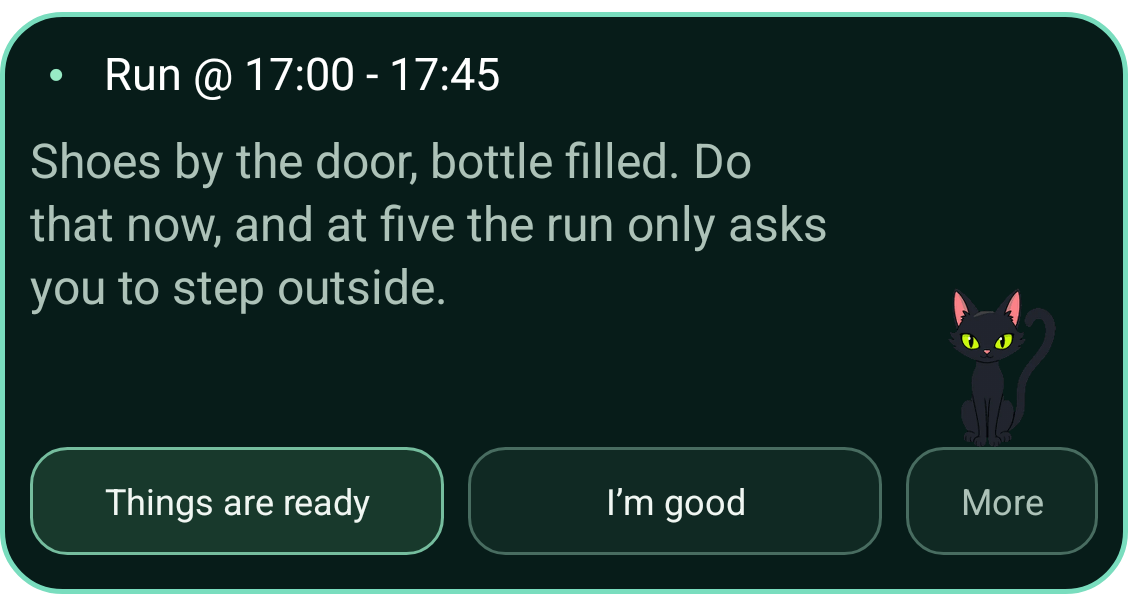
More than "it is time"
A plain reminder tells you what you already know. Grip offers a way to begin instead, and the way changes depending on the task and on you. A few examples:
- Make the first step tiny: open the document and write one rough line
- Prepare in advance: shoes by the door, bottle filled
- Try just 10 minutes, with your coach working beside you
- Blast off: your coach counts down from five out loud, then you go
- Breathe for a minute first, with a circle that grows and shrinks while your coach says in and out
You choose how much help
Per task, or per type of task: a helping hand with a first step, a plain reminder with just the task and the time, or quiet with no card at all.
Built on how people actually get unstuck
The ideas come from research on first-person accounts of people struggling to start things and the strategies they said helped. That work produced ten broad kinds of support. There is no single trick that works every time, so Grip keeps several.
It learns what works for you
Every answer you give on the widget tells Grip something: what helped, what you ignored and what was badly timed. When you skip, you can say why in one tap, from "Too tired" to "Couldn't start".
You can also rate the nudges you got in Judge the Nudge. Over time Grip offers the kinds of help that work for you, and you get a clearer picture of how you work too.
Good to know
- Is this the same as a reminder app?
- No. Reminders say when. Grip tries to make the first step easier, and asks how it went afterwards.
- What if a suggestion is wrong for me?
- Tap More and tell it. "Not a good time" and "Stop these" are always there, and your answers shape what comes next.